

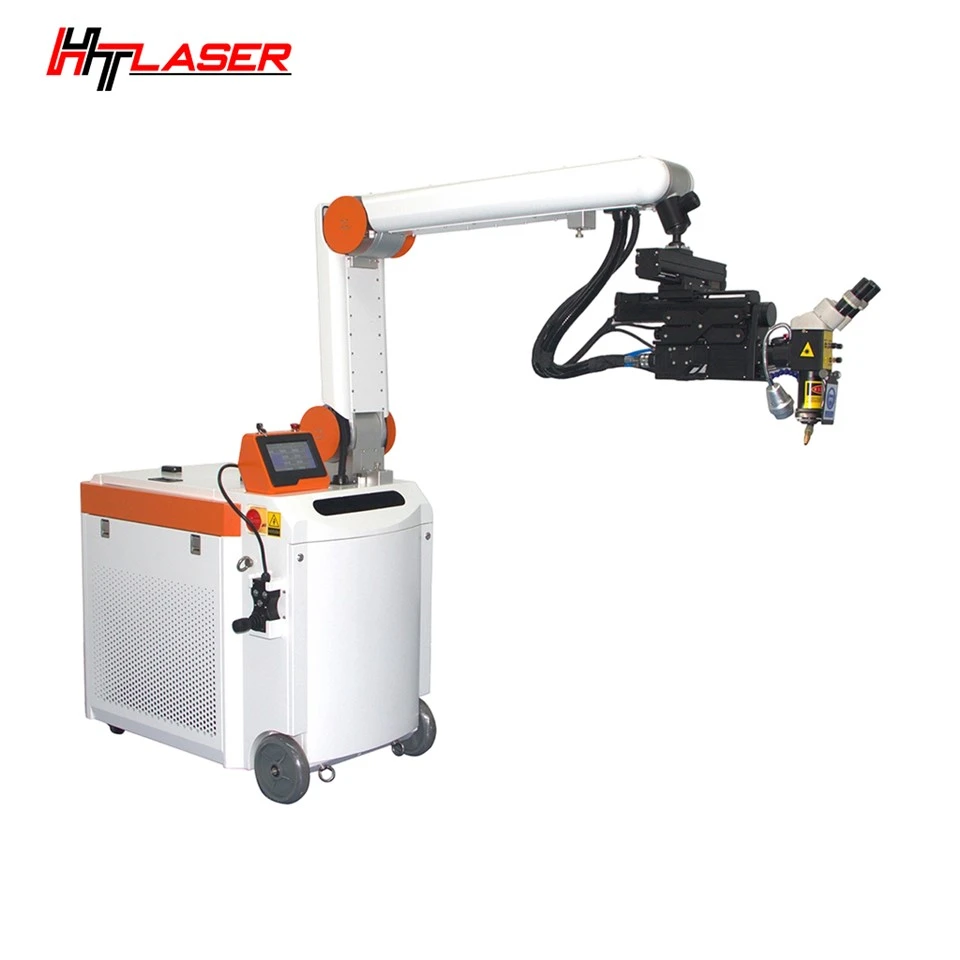

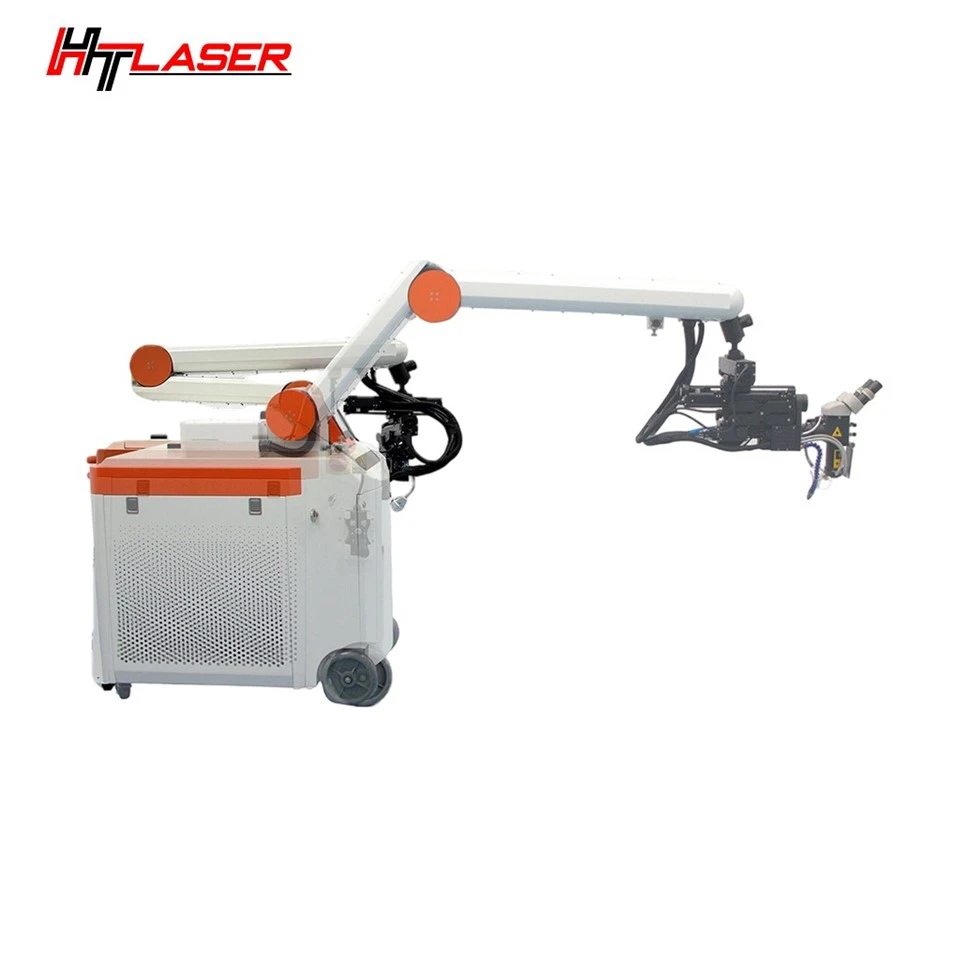
The Cantilever Arm Laser Welding System combines a double-section cantilever arm with fiber laser technology for welding large, heavy, complex, or difficult-to-position metal workpieces.
Three models are available: HT-MDS-QCW150, HT-MDS-QCW300, and HT-MDS1500, covering Quasi-Continuous Wave (QCW) pulsed laser and high-power fiber laser welding requirements.
Technical Specifications
|
Item |
HT-MDS-QCW150 |
HT-MDS-QCW300 |
HT-MDS1500 |
|
Laser Type |
QCW fiber laser |
QCW fiber laser |
Fiber laser |
|
Laser Power |
150 W |
300 W |
1500 W |
|
Spot Size |
0.2–3.0 mm |
0.2–3.0 mm |
0.2–5.0 mm |
|
Wavelength |
1080 ± 10 nm |
1080 ± 10 nm |
1080 ± 10 nm |
|
Pulse Width |
≤20 ms |
≤20 ms |
≤60 ms |
|
Pulse Frequency |
≤30 Hz |
≤30 Hz |
≤5000 Hz |
|
Cooling |
Water cooling |
Water cooling |
Water cooling |
|
Observation |
CCD + 360° adjustable microscope |
CCD + 360° adjustable microscope |
CCD + 360° adjustable microscope |
|
Power Supply |
AC220V, 50/60 Hz |
AC220V, 50/60 Hz |
AC220V, 50/60 Hz |
|
Machine Dimensions |
1380 × 1000 × 1240 mm |
1380 × 1000 × 1240 mm |
1380 × 1000 × 1240 mm |
|
Vertical Extension |
1500 mm |
1500 mm |
1500 mm |
|
Horizontal Reach |
1600 mm |
1600 mm |
1600 mm |
Welding Performance
QCW 150 W - For precision welding requiring localized heat input and controlled pulsed energy.
QCW 300 W - Provides higher peak-energy output for applications requiring greater welding capability.
1500 W Fiber Laser - For higher-power welding applications requiring greater energy input and production efficiency.
Adjustable Spot Size - 0.2–3.0 mm for QCW models and 0.2–5.0 mm for the 1500 W model.
Filler Wire - Can be integrated when joint gaps or weld geometry require additional material.
Core Advantages
Long Reach, High Rigidity - 1600 mm horizontal reach with a rigid double-section cantilever.
Stationary Workpiece Welding - The arm moves around heavy workpieces, minimizing repositioning.
Reduced Blind Zones - Access to side, edge, recessed, and elevated welds.
Three Laser Options - 150 W/300 W QCW and 1500 W fiber laser configurations.
360° Observation - Adjustable CCD and microscope for different welding angles.
Water Cooling - Stable thermal management for continuous operation.
Typical Applications
|
Application |
Typical Workpieces |
|
Sheet metal fabrication |
Cabinets, panels, frames, covers |
|
Metal housings |
Chassis, enclosures, equipment housings |
|
Automotive components |
Fabricated metal parts and assemblies |
|
Industrial machinery |
Frames, brackets, machine components |
|
Structural assemblies |
Large frames and metal structures |
|
Mold & tool repair |
Localized repair and buildup welding |
The cantilever configuration is most valuable when workpiece size, weight, or weld location makes repeated repositioning inefficient.
Materials & Welding Range
Carbon Steel - Suitable for general fabrication, frames and machinery components; laser power is selected according to thickness and joint geometry.
Stainless Steel - Suitable for housings, enclosures and precision assemblies where controlled heat input is required.
Aluminum Alloys - Requires parameter validation according to alloy grade, thickness, and joint configuration.
Galvanized Steel - Requires process control for coated surfaces and joint preparation.
Copper Alloys - Requires appropriate laser power and process parameters because of high reflectivity and thermal conductivity.
Custom Configuration
The system can be customized according to the actual production requirements:
Cantilever reach - Matched to workpiece dimensions and weld locations.
Welding-head access - Configured for side, edge, recessed, or elevated welds.
Worktable and fixture - Selected according to workpiece weight and positioning requirements.
Observation system - Adjusted according to welding direction and operator visibility.
Rotary axis - Configured for cylindrical or rotational components.
Automation - Added according to production volume and positioning requirements.
Safety & Compliance
The system is supplied with laser safety protection and should be installed and operated according to applicable local laser-safety and workplace requirements.
Relevant documentation can include:
- CE Certification
- FDA Certification
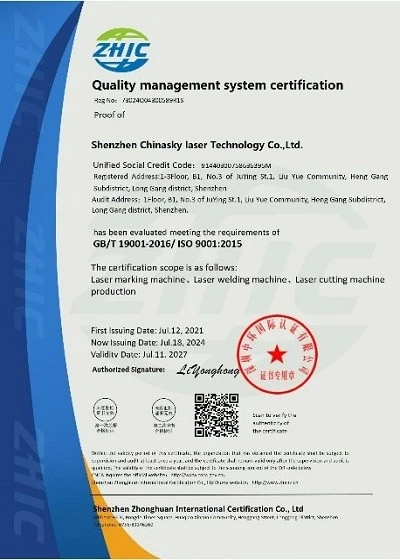
- ISO 9001:2015
- Equipment technical documentation
- Operation and maintenance documentation

Installation & After-Sales Support
Support covers the equipment lifecycle from installation to routine operation:
Installation & Commissioning - Support machine setup, laser alignment, motion-system checks, and initial welding trials.
Operator Training - Training covers machine operation, parameter adjustment, workpiece positioning, and daily safety checks.
Process Setup - Assist with initial welding parameter setup based on the confirmed material, thickness, joint type, and welding requirements.
Maintenance Guidance - Provide procedures for routine inspection, protective-lens replacement, cleaning, cooling-system checks, and other scheduled maintenance.
Spare Parts Support - Identify and supply replacement parts and consumables according to the machine configuration.
Remote Technical Support - Assist with equipment alarms, parameter issues, and basic troubleshooting through remote communication.
Overseas Service - Installation, commissioning, and on-site service arrangements can be confirmed according to project requirements and service scope.
FAQ
Q: What makes a cantilever arm laser welding system different from a conventional laser welding machine?
A: Its main advantage is the arm-based access to the workpiece. The welding head can be positioned around a stationary component, making the system more suitable for parts where conventional machine layouts limit welding access.
Q: Is the cantilever arm suitable for heavy workpieces?
A: Yes. The design keeps the workpiece stationary during welding, so large components do not need to be repeatedly moved to follow different weld positions. The allowable load still depends on the worktable and fixture configuration.
Q: How do I know whether my workpiece fits the welding envelope?
A: Provide the complete part dimensions, weight, weld-location drawing, and fixture height. These details allow the usable reach and access to be checked against the actual component rather than its overall dimensions alone.
Q: Can the machine weld components with welds on multiple sides?
A: Yes, provided the required welding positions are within the cantilever's working envelope. The arm configuration is intended to provide access to different welding directions without repeatedly repositioning the main workpiece.
Q: Can the system be integrated into an existing production line?
A: Application-specific integration can be evaluated for fixtures, rotary positioning, wire feeding, CNC movement, vision systems, and other production equipment. Existing process layout and interface requirements should be provided before configuration.
Q: Can you test our parts before we order the machine?
A: Yes. Customers can provide samples, drawings, or welding requirements for process evaluation. Testing can help determine the appropriate laser configuration and welding process before final equipment selection.
Hot Tags: cantilever arm laser welding system, China cantilever arm laser welding system manufacturers, suppliers, factory, 2000W Robotic Laser Welding Machine, Benchtop Jewelry Laser Welding Machine, Galvo Head Handheld Laser Welding Machine, Laser Welder For Jewelry Repair With Ccd, laser welding machine, Laser Welding Machine For Mold


